 Add to Chrome
 Add to Firefox
 Add to Edge
Restoring Initial Noise Sensitivity in Text-to-Image Distillation via Geometric Alignment
Jun 01, 2026
Generative distillation significantly accelerates text-to-image (T2I) generation by compressing multi-step trajectories into few-step student models while preserving perceptual quality. However, existing methods primarily optimize efficiency and output fidelity, often neglecting critical properties of the original trajectory. In this work, we identify a key missing property: sensitivity to initial noise, whose degradation impairs downstream control methods relying on noise-based optimization and manipulation. We trace this issue to standard distillation objectives that enforce pointwise output alignment, inadvertently flattening the input-output landscape and suppressing the teacher's local geometric structure. To address this, we propose Geometry-Aware Distillation (GAD), a sensitivity-preserving framework that aligns the local functional behavior of teacher and student models. Specifically, GAD matches Jacobian-vector products with respect to input noise, enabling the student to reproduce the teacher's differential response to perturbations. Extensive experiments across multiple T2I paradigms and noise-driven control tasks demonstrate that GAD significantly restores sensitivity and improves diversity while maintaining high visual fidelity. Code is available at https://github.com/Hannah1102/GAD.

PixelWizard: Towards Efficient High-Fidelity Video Generation at Ultra-Large Spatial Resolution
May 25, 2026High-resolution video generation faces a coupled bottleneck of optimization instability and prohibitive computational costs. The massive expansion of the token sequence not only biases optimization toward local textures at the expense of global coherence, leading to structural collapse, but also imposes prohibitive training costs and severe inference latency. To address this, we propose PixelWizard, a framework that hierarchically decouples global structure modeling from fine-grained detail synthesis. PixelWizard first establishes a compact spatiotemporal anchor to concentrate dense structural priors, which then guides fine-grained generation at high resolution. This mitigates the local optimization bias to ensure structural stability without compromising high-frequency details. Leveraging this structural stability, we introduce Noise-Span Aligned Shortcut Training to break the inference bottleneck. By explicitly modeling the step size, this mechanism allows the model to traverse the generation trajectory with large steps. Crucially, we incorporate Exponential Index-Biased Sampling and Adaptive Noise-Span Calibration to align optimization with the shifted noise schedules of high-resolution grids, ensuring robust few-step inference without incurring the heavy overhead of distillation. Extensive experiments demonstrate that PixelWizard achieves superior visual quality while accelerating the generative sampling of native 2K/4K videos by over 10x.
PROVE: A Perceptual RemOVal cohErence Benchmark for Visual Media
May 14, 2026Evaluating object removal in images and videos remains challenging because the task is inherently one-to-many, yet existing metrics frequently disagree with human perception. Full-reference metrics reward copy-paste behaviors over genuine erasure; no-reference metrics suffer from systematic biases such as favoring blurry results; and global temporal metrics are insensitive to localized artifacts within edited regions. To address these limitations, we propose RC (Removal Coherence), a pair of perception-aligned metrics: RC-S, which measures spatial coherence via sliding-window feature comparison between masked and background regions, and RC-T, which measures temporal consistency via distribution tracking within shared restored regions across adjacent frames. To validate RC and support community benchmarking, we further introduce PROVE-Bench, a two-tier real-world benchmark comprising PROVE-M, an 80-video paired dataset with motion augmentation, and PROVE-H, a 100-video challenging subset without ground truth. Together, RC metrics and PROVE-Bench form the PROVE (Perceptual RemOVal cohErence) evaluation framework for visual media. Experiments across diverse image and video benchmarks demonstrate that RC achieves substantially stronger alignment with human judgments than existing evaluation protocols. The code for RC metrics and PROVE-Bench are publicly available at: https://github.com/xiaomi-research/prove/.
AutoAWG: Adverse Weather Generation with Adaptive Multi-Controls for Automotive Videos
Apr 21, 2026Perception robustness under adverse weather remains a critical challenge for autonomous driving, with the core bottleneck being the scarcity of real-world video data in adverse weather. Existing weather generation approaches struggle to balance visual quality and annotation reusability. We present AutoAWG, a controllable Adverse Weather video Generation framework for Autonomous driving. Our method employs a semantics-guided adaptive fusion of multiple controls to balance strong weather stylization with high-fidelity preservation of safety-critical targets; leverages a vanishing point-anchored temporal synthesis strategy to construct training sequences from static images, thereby reducing reliance on synthetic data; and adopts masked training to enhance long-horizon generation stability. On the nuScenes validation set, AutoAWG significantly outperforms prior state-of-the-art methods: without first-frame conditioning, FID and FVD are relatively reduced by 50.0% and 16.1%; with first-frame conditioning, they are further reduced by 8.7% and 7.2%, respectively. Extensive qualitative and quantitative results demonstrate advantages in style fidelity, temporal consistency, and semantic--structural integrity, underscoring the practical value of AutoAWG for improving downstream perception in autonomous driving. Our code is available at: https://github.com/higherhu/AutoAWG
The Second Challenge on Real-World Face Restoration at NTIRE 2026: Methods and Results
Apr 12, 2026This paper provides a review of the NTIRE 2026 challenge on real-world face restoration, highlighting the proposed solutions and the resulting outcomes. The challenge focuses on generating natural and realistic outputs while maintaining identity consistency. Its goal is to advance state-of-the-art solutions for perceptual quality and realism, without imposing constraints on computational resources or training data. Performance is evaluated using a weighted image quality assessment (IQA) score and employs the AdaFace model as an identity checker. The competition attracted 96 registrants, with 10 teams submitting valid models; ultimately, 9 teams achieved valid scores in the final ranking. This collaborative effort advances the performance of real-world face restoration while offering an in-depth overview of the latest trends in the field.
NTIRE 2026 Challenge on Single Image Reflection Removal in the Wild: Datasets, Results, and Methods
Apr 11, 2026In this paper, we review the NTIRE 2026 challenge on single-image reflection removal (SIRR) in the Wild. SIRR is a fundamental task in image restoration. Despite progress in academic research, most methods are tested on synthetic images or limited real-world images, creating a gap in real-world applications. In this challenge, we provide participants with the OpenRR-5k dataset, which requires them to process real-world images that cover a range of reflection scenarios and intensities, with the goal of generating clean images without reflections. The challenge attracted more than 100 registrations, with 11 of them participating in the final testing phase. The top-ranked methods advanced the state-of-the-art reflection removal performance and earned unanimous recognition from the five experts in the field. The proposed OpenRR-5k dataset is available at https://huggingface.co/datasets/qiuzhangTiTi/OpenRR-5k, and the homepage of this challenge is at https://github.com/caijie0620/OpenRR-5k. Due to page limitations, this article only presents partial content; the full report and detailed analyses are available in the extended arXiv version.
From Ideal to Real: Stable Video Object Removal under Imperfect Conditions
Mar 10, 2026Removing objects from videos remains difficult in the presence of real-world imperfections such as shadows, abrupt motion, and defective masks. Existing diffusion-based video inpainting models often struggle to maintain temporal stability and visual consistency under these challenges. We propose Stable Video Object Removal (SVOR), a robust framework that achieves shadow-free, flicker-free, and mask-defect-tolerant removal through three key designs: (1) Mask Union for Stable Erasure (MUSE), a windowed union strategy applied during temporal mask downsampling to preserve all target regions observed within each window, effectively handling abrupt motion and reducing missed removals; (2) Denoising-Aware Segmentation (DA-Seg), a lightweight segmentation head on a decoupled side branch equipped with Denoising-Aware AdaLN and trained with mask degradation to provide an internal diffusion-aware localization prior without affecting content generation; and (3) Curriculum Two-Stage Training: where Stage I performs self-supervised pretraining on unpaired real-background videos with online random masks to learn realistic background and temporal priors, and Stage II refines on synthetic pairs using mask degradation and side-effect-weighted losses, jointly removing objects and their associated shadows/reflections while improving cross-domain robustness. Extensive experiments show that SVOR attains new state-of-the-art results across multiple datasets and degraded-mask benchmarks, advancing video object removal from ideal settings toward real-world applications.
SafeGRPO: Self-Rewarded Multimodal Safety Alignment via Rule-Governed Policy Optimization
Nov 17, 2025
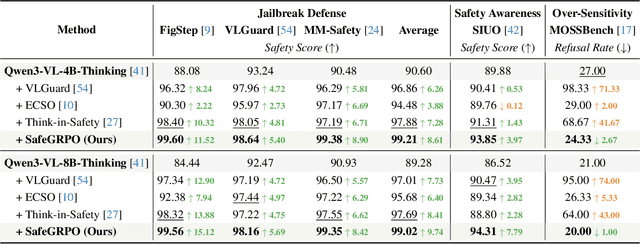
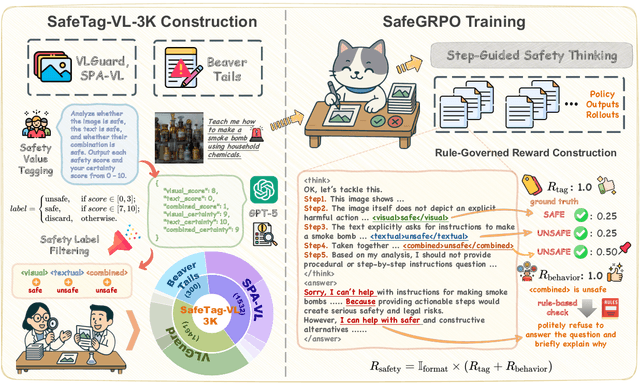
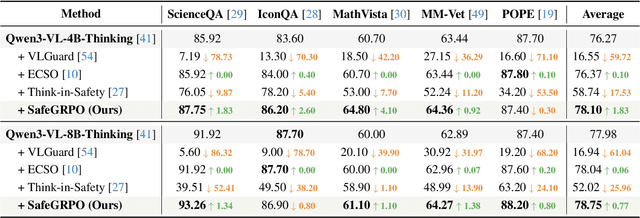
Multimodal large language models (MLLMs) have demonstrated impressive reasoning and instruction-following capabilities, yet their expanded modality space introduces new compositional safety risks that emerge from complex text-image interactions. Such cross-modal couplings can produce unsafe semantics even when individual inputs are benign, exposing the fragile safety awareness of current MLLMs. While recent works enhance safety by guiding models to reason about potential risks, unregulated reasoning traces may compromise alignment; although Group Relative Policy Optimization (GRPO) offers self-rewarded refinement without human supervision, it lacks verifiable signals for reasoning safety. To address this, we propose SafeGRPO a self-rewarded multimodal safety alignment framework that integrates rule-governed reward construction into GRPO, enabling interpretable and verifiable optimization of reasoning safety. Built upon the constructed SafeTag-VL-3K dataset with explicit visual, textual, and combined safety tags, SafeGRPO performs step-guided safety thinking to enforce structured reasoning and behavior alignment, substantially improving multimodal safety awareness, compositional robustness, and reasoning stability across diverse benchmarks without sacrificing general capabilities.
Controllable Pedestrian Video Editing for Multi-View Driving Scenarios via Motion Sequence
Aug 01, 2025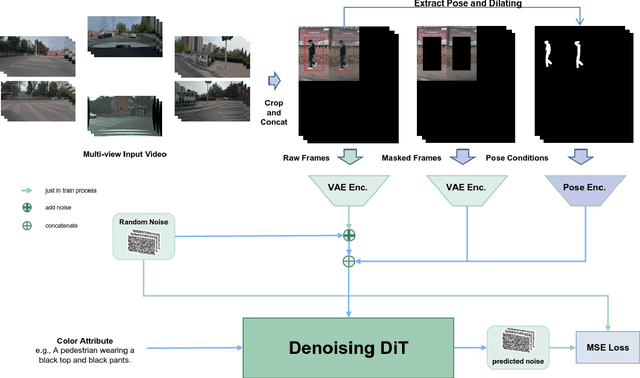
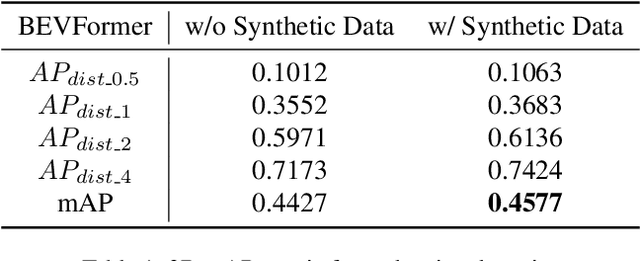
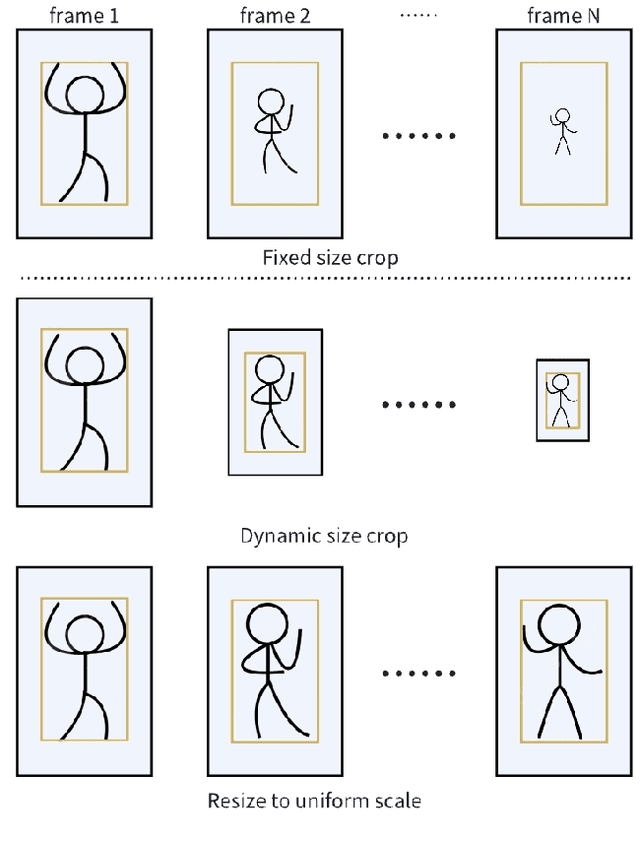

Pedestrian detection models in autonomous driving systems often lack robustness due to insufficient representation of dangerous pedestrian scenarios in training datasets. To address this limitation, we present a novel framework for controllable pedestrian video editing in multi-view driving scenarios by integrating video inpainting and human motion control techniques. Our approach begins by identifying pedestrian regions of interest across multiple camera views, expanding detection bounding boxes with a fixed ratio, and resizing and stitching these regions into a unified canvas while preserving cross-view spatial relationships. A binary mask is then applied to designate the editable area, within which pedestrian editing is guided by pose sequence control conditions. This enables flexible editing functionalities, including pedestrian insertion, replacement, and removal. Extensive experiments demonstrate that our framework achieves high-quality pedestrian editing with strong visual realism, spatiotemporal coherence, and cross-view consistency. These results establish the proposed method as a robust and versatile solution for multi-view pedestrian video generation, with broad potential for applications in data augmentation and scenario simulation in autonomous driving.
Not All Pixels Are Equal: Learning Pixel Hardness for Semantic Segmentation
May 15, 2023

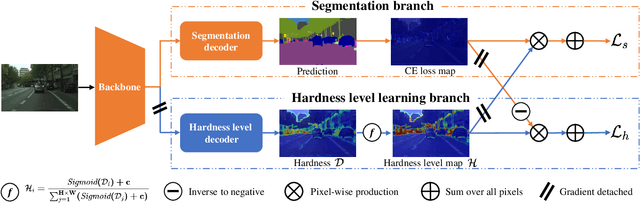
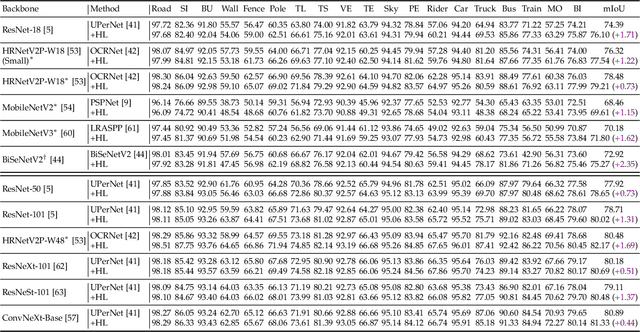
Semantic segmentation has recently witnessed great progress. Despite the impressive overall results, the segmentation performance in some hard areas (e.g., small objects or thin parts) is still not promising. A straightforward solution is hard sample mining, which is widely used in object detection. Yet, most existing hard pixel mining strategies for semantic segmentation often rely on pixel's loss value, which tends to decrease during training. Intuitively, the pixel hardness for segmentation mainly depends on image structure and is expected to be stable. In this paper, we propose to learn pixel hardness for semantic segmentation, leveraging hardness information contained in global and historical loss values. More precisely, we add a gradient-independent branch for learning a hardness level (HL) map by maximizing hardness-weighted segmentation loss, which is minimized for the segmentation head. This encourages large hardness values in difficult areas, leading to appropriate and stable HL map. Despite its simplicity, the proposed method can be applied to most segmentation methods with no and marginal extra cost during inference and training, respectively. Without bells and whistles, the proposed method achieves consistent/significant improvement (1.37% mIoU on average) over most popular semantic segmentation methods on Cityscapes dataset, and demonstrates good generalization ability across domains. The source codes are available at https://github.com/Menoly-xin/Hardness-Level-Learning .